Tuesday, March 18, 2014

Israel--My favorite things, part II


Bethlehem as seen from Herod's Winter Palace.  The red-roofed houses in the foreground are an Israeli West Bank settlement.


 Here are the rest of the best things I saw and experienced on my recent trip to Israel:

               Bethlehem: There is much to see in Jesus’ birthplace.  The Church of the Nativity is the main attraction.  This Orthodox Church claims to be built on the site where the Christ child was born.  Adjoining it is the Catholic Church of St. Catherine, from which Midnight Mass is broadcast around the world every year on Christmas Eve.  And there’s the Milk Grotto, a small church where Mary, Joseph and Jesus—according to a legend not found in the Bible—stopped on their way out town.  There are also Solomon’s Pools, the tomb of Rachel and the cave where St. Jerome translated the Vulgate.  Those things, while interesting, were not as meaningful to me as an insight I had while in the place where Christ was born: 
               I must admit, it didn’t look the way I imagined it when I sang “O Little Town of Bethlehem.”  There is great poverty in the town, which relies on tourism for most of its economy.  Bethlehem is in the Palestinian territory known as the West Bank.  Although it’s only 5 miles from Jerusalem, it took us quite a while to get there.  We took a public bus to the security fence separating Israel from the West Bank.  We walked past the hundreds of Palestinian men waiting in line to be passed through the gate so they could get to work; something they must do every day.  As we visited Herod’s Winter Palace, which sits on a hill high above the town, we could clearly see an Israeli settlement, the cause of intense anger in this region.  I thought about how the world hasn’t changed all that much in 2000 years; on the night Jesus was born, Herod loomed (literally and figuratively) over this small town, and would soon unleash horrific violence on Bethlehem, ordering the slaughter of its infants in an attempt to eliminate the Messiah.  Human politics and ambition will always seem to trump grace; but two millennia later, we know who prevailed between Herod and Jesus.  Grace is intrepid.  Tyranny cannot stop it.  While I was thinking about that, someone pointed to the hills nearby, where shepherds were tending their sheep.

O Little Town of Bethlehem: Not the way I pictured it.
    
"There were shepherds in the fields..."  Can you see them in my crummy iphone picture?
               Dead Sea: It was cold the day we visited the Dead Sea, so I almost backed out.  But friends who had been to Israel before me had told me I HAD to get in.  They were right.  When I sat back into that water and fel5 like I was sitting in an easy chair, my brain didn’t know what to do with that information.  It was like nothing I’ve ever experienced.  Another memorable experience from that same morning: We were standing in a desert field, looking at the backside of Masada (the fortress that overlooks the Dead Sea).  Suddenly, a small truck drove up.  The man inside warned us to leave quickly; the wadis nearby were flooding, and we would be stranded here if we didn’t get out soon.  It only rains around 3 times a year in this region; we just happened to visit on the day after a heavy rain.  We quickly got into our cars and hit the highway, which was already beginning to flood.  We made it across, but were glad we didn’t wait a few minutes more.  It seemed like the kind of thing Jesus would have told a parable about: When God tells you to move, don’t tarry even a minute.  Do the right thing, and do it now.   

The flash flood that almost got us.

               Capernaum: The hometown of Peter and Andrew, James and John, and the base of so much of Jesus’ ministry sits right on the shores of the Sea of Galilee.  A house that very likely belonged to Peter has a church built over its top.  It has a glass floor, so that worshippers can look down into the house where Jesus and the disciples likely slept, ate and learned together.  Just a few yards away are the ruins of the synagogue.  Mark 1 tells us on one Sabbath near the start of Jesus’ ministry, He went to that synagogue to teach.  While in the middle of His sermon, a demonized man stood up and began to shout at Jesus.  The Lord rebuked the demon and cast it out.  After the service was over, Jesus walked to Peter’s house and healed his mother-in-law, who was lying sick with a fever there.  That was just the beginning; Jesus did numerous amazing things in Capernaum.  Do a quick search of Capernaum in your Bible.  It is mentioned more times in the Gospels than any other city besides Jerusalem.  No wonder there is a sign outside the town that says, “Capernaum, the town of Jesus.”  But later in His ministry, Jesus condemned Capernaum (Matthew 11:23-24).  Although they had witnessed so many miracles and spent so much time around Jesus, they had not changed their hearts.  He said that it would be better on the Day of Judgment for the citizens of Sodom than for those of Capernaum.  It is a poignant reminder that those who have the most access to Jesus can often be the most unrepentant and far from God.  Would God say that about American Christianity?  One wonders…

This may have been Peter's house.  It was built in an octagonal shape.

The synagogue in Capernaum, as seen from Peter's house.

The church suspended over Peter's house.

               Megiddo: According to Revelation, this hill will overlook the climactic battle that will end the present age.  Armageddon is “hill of Megiddo.”  The fortress of Megiddo has been destroyed and rebuilt twenty-five times through the centuries.  The Jezreel Valley below is the site of numerous huge biblical events, including Gideon’s miraculous victory over the Midianites.  As I stood atop the highest point of Megiddo, I thought about the future as well as the past. And I had a stunning 360 degree view of Israel.  


               The Sea of Galilee: Jesus spent so much time on and around the waters of this lake.  Here, He stilled the storm and walked on water.  He sat in a boat just off the shore and taught the crowds.  He recruited Peter with a miraculous catch of fish.  And following His resurrection, He appeared to the disciples on the shoreline while they were in the water after a long, fruitless night of fishing.  Our group went out on a boat.  Tim invited me to share a devotional, and it was my great privilege to teach the Word of God on the Sea of Galilee.  As we headed back toward the shore, I kept thinking about Jesus standing on dry ground, John looking at Him and saying, “It is the Lord,” and wonderful, impulsive Peter jumping into the water to swim to Him.  I need to have that kind of love for Jesus. 

Sunset over the Sea of Galilee

My "St Peter's Fish" dinner at a restaurant on the shores of the Sea of Galilee.  It was delicious, even if it was probably imported tilapia.

A once in a lifetime experience: Teaching from the Word on the Sea of Galilee.  God threw in the rainbow because, well, that's how He is. 
    

Monday, March 17, 2014

Israel--My favorite things, part I


The hill that might be Golgotha: Note the two "eyes" of the skull overlooking the Garden Tomb.  The "mouth" once visible is now covered by a city street.

 Earlier, I listed all the stuff I saw and experienced on my ten-day trip to Israel (see Israel--a ten-day adventure).  Now, I’d like to focus on my favorite experiences in the Holy Land.  These are the things I would most like to see again, and would most highly recommend to anyone traveling there.  It was hard to limit myself to just ten, but over the next two posts, I’d like to list my ten favorite things, in no particular order.  

               The Garden Tomb: Hands-down, this was the most meaningful place for me.  The traditional site for Christ’s crucifixion, burial and resurrection is inside the Church of the Holy Sepulcher.  It is an ancient church that is an impressive site in its own right.  There is a shrine over the place where the cross was thought to be planted and another over the grotto where the resurrection is thought to have occurred.  The church has existed for over 1500 years.  Kings have been consecrated here.  To this day, pilgrims come from thousands of miles away to pray at the Anointing Stone, which they believe to be the very rock slab that Jesus’ body was laid upon as it was prepared for burial.  The problem is…I don’t believe it.  The Church is a site of profound veneration, but I doubt seriously that this was where my salvation took place.  I will not take the time to explain here, but you can examine the arguments online easily.

"Calvary" at the Church of the Holy Sepulcher.  Note the person kneeling beneath the table in the foreground.  He is praying over a hole some believe is the place where Christ's cross was planted. 

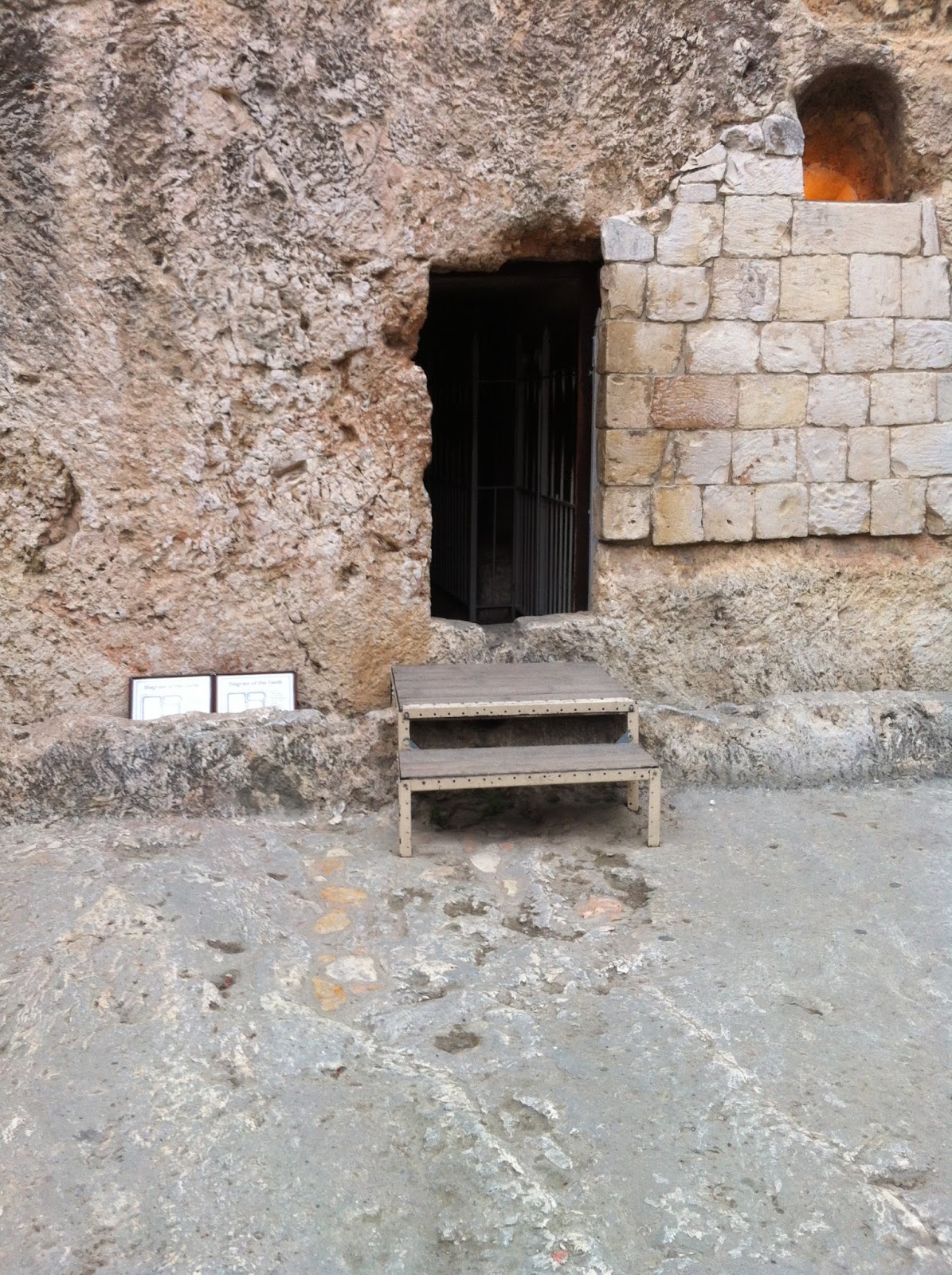
               The Garden Tomb was discovered in the mid-1800s.  Observers noted a small hill just outside the city gates (Scripture says Christ was crucified outside the gates) that appeared to be shaped like a skull.  Excavations revealed an olive press that dated to the first century AD, and a nearby tomb cut into the limestone.  Today, the Garden Tomb is administered by a British ministry.  Our guide at the Garden Tomb was Graham, a retired pastor from Liverpool (Yes, he went to school with two of the Beatles, though he didn’t say which two).  As he said, “This may or may not be the exact place where Christ was crucified, buried and raised.  The important thing is that it did happen.”  Sitting in that quiet place, I could picture my Lord dying for me.  Walking into the small tomb, I saw the groove where the stone would have been rolled into place.  I saw the chamber where the body would have lain.  If it didn’t happen here, it happened in a place much like this. 

The Garden Tomb
    
The groove where the stone would have been set, sealing the tomb.  Someone was buried here in the First Century.  It may have been Jesus.
               
Interior of the Garden Tomb.  Looking past the bars, you see two burial chambers, one on each side.  As I took the picture, I was standing where Mary Magdalene first saw the angel; and where later Peter and John would have stood, examining the discarded grave clothes.

                      Christ Church: It’s not so much the place as the person I met here that makes this one of my favorite locations.  Christ Church is the oldest Protestant church in the Middle East.  Our tour leader, Tim, had arranged for us to meet there with a Messianic Christian, Linda Cohen.  Linda was actually born and raised in New Jersey, in a conservative Jewish family.  When her mother died on Rosh Hashanah, she began to question her faith in God.  She had a friend who was a strong Christian, who invited her to church one Christmas Eve when she was seventeen.  Her first experience of Christian worship was very moving; these people seemed to really know and trust God, rather than simply repeating ancient rituals.  She began attending a Bible study with her friend during college.  Eventually, she prayed, “Jesus, if you’re real, please show me.”  Jesus took away the profound pain she felt over the loss of her mother and other loved ones.  Linda now works for an organization called The Church’s Ministry to Jews (CMJ).  She has lived in Jerusalem since 1999, and considers it her home.  There are now 15-20,000 Messianic Jews in Israel, and although the overall number of Christians in the Holy Land is declining, CMJ is seeing significant growth and openness among Jews in recent years.    
               Hezekiah’s Tunnel: When the fierce Assyrian army threatened to besiege Judah some 700 years before Christ, righteous King Hezekiah knew that if the Jews were to survive a long siege, they would need a water source.  So he ordered a tunnel to be dug funneling the waters of the Gihon Spring beneath the walls of Jerusalem and into the city.  We walked Hezekiah’s tunnel.  It is nearly 600 yards long, filled with water that is shin-deep (it came up to my thigh at one point).  It took us 23 minutes to walk the entire distance.  The tunnel is narrow—my shoulders nearly touched on both sides—and short—I had to stoop for over half the walk.  It’s also pitch dark; we had to carry flashlights.  It’s not a place for claustrophobics. But it was a fun, unique experience that I heartily recommend.  

Inside Hezekiah's tunnel.  Note how narrow it is, and the depth of the water.

               The Valley of Hinnom: It’s ironic for this site to make the list.  The Valley of Hinnom was the site of child sacrifice to the false god Molech during the Old Testament era.  They also called it Topheth, place of the drums, because the worshippers beat drums to drown out the screams of infants being cast into the fire.  As we stood overlooking that valley, I thought about Solomon, once so wise and close to God, watching as his own infant sons were killed there, sacrificed to the beliefs of his pagan wives.  It made me think about how easily we can allow sin to take us places we never thought we’d go, cause us to make decisions which would have been unimaginable before.  I pictured young King Josiah smashing idols and purifying the Valley hundreds of years later.  And then I pictured Jesus standing over the valley, talking about the fate that awaits those who reject God’s grace.  By then, the Jews had transformed Hinnom into a dumping ground for garbage and the bodies of the unclaimed dead.  There, the fires never went out.  The stench must have been unimaginable.  In the Aramaic that Jesus spoke, the place was called Gehenna, and Jesus used it as a metaphor for Hell.  Today, Gehenna looks like any other valley.  But Christ’s words about it remind us that everyone will spend eternity somewhere.  That knowledge should motivate us to share His love with people who haven't experienced it yet.   

Gehenna today

               Mount of Olives: Jerusalem sits on a hill overlooking two valleys-The Valley of Hinnom and the Kidron Valley.  Across Kidron stands the Mount of Olives.  This is where Jesus taught His Olivet Discourse, about the coming destruction of Jerusalem and the Day of Judgment (Matthew 24-25).  On the backside of the Mount is the ancient city of Bethany, where Jesus stayed at the home of Lazarus, Mary and Martha during the week of His crucifixion.  Somewhere on the Mount of Olives was a garden of olive trees called Gethsemane (“Olive Press”).  And Jesus was standing with His disciples on the Mount when He ascended into Heaven.  We walked up the Mount and saw how very steep it is.  Jesus was in good shape to make that trip every day during Holy Week.  We saw His view of the city of Jerusalem as He made that walk.  We saw a Jewish cemetery there, where visitors have placed rocks on the vaults (rocks are more permanent than flowers; a sign that someone has visited).  And we remembered that Christ is coming back, the same way He left us from that Mountain.  On that day, graves won’t hold His people.  

The view Jesus would have had walking to Jerusalem from the Mount of Olives.

Israel--The Old City of Jerusalem


The busy streets of the Muslim Quarter.


 Note: I just returned from my first trip to Israel, and I am posting my thoughts and remembrances here.  In my previous post, I summarized the entire adventure.

We spent the better part of our trip in the Old City of Jerusalem, so I need to spend some time writing about this ancient city.  Jerusalem has an incredible history.  It originally belonged to the Jebusites, before it was conquered by David.  It was then Israel’s spiritual and political capital for centuries, until the Babylonians invaded, destroyed Solomon’s Temple and the walls of the city, then deported most of the people.  After the exile (foretold by the prophets), Cyrus the Persian King allowed the Jews to repopulate Jerusalem and rebuild the Temple. In the stunning Maccabean revolution, the Jews claimed independence from their Syrian overlords, and cleansed the Temple in an event the Jews commemorate at Hannukhah.  But their independence was short-lived.  By Jesus’ day, Jerusalem was a Jewish city under Roman rule. When the Jews rebelled in 68-70 AD (foretold by Jesus in Matthew 24, the Romans destroyed the Temple.  A second rebellion in 132-135 AD caused the Romans to expel all Jews from the city and name it Aelia Capitolina.   After the rise of Islam, Jerusalem was claimed as a Muslim city; the Dome of the Rock was built on the former site of the Temple.  During the Crusades, Christians conquered Jerusalem and declared it a Christian Kingdom, which lasted for nearly two hundred years before being reclaimed by Muslim warriors.  In 1948, the United Nations granted the Jews the homeland of Israel, leading to the Arab-Israeli war that year, and a tenuous co-existence between Jews and Palestinians ever since.  

Zion Gate.  Note the many bullet holes from the 1948 war.


Jerusalem is a modern Middle-Eastern city, but it surrounds an ancient walled city that in many ways is like traveling in a time machine to the biblical era.  This is the Old City of Jerusalem.  The Old City features narrow streets, many of them filled with merchants peddling food, clothes, souvenirs, and artwork; a massive wall with walkable ramparts, “loopholes” designed to allow archers to snipe at invading troops, and several historic gates; and amazing history on virtually every square inch.  In Texas, we love to visit places like the Alamo, San Jacinto, and Gonzales, where momentous events occurred two centuries ago.  In Jerusalem, I walked in a city where history was made two millennia ago—and more.  The city is so filled with history, Tim showed us a lamp post built on a column inscribed with the names of Roman soldiers stationed here two thousand years ago; in America, we would venerate such an object.  In Jerusalem, it’s a lamp post.  There are approximately 40,000 people living in the Old City today; According to Josephus, there were around a million people in the city when the Romans destroyed it in 70 AD.

One of many "loopholes" in the wall.  These allowed archers to snipe at invading troops.
  
A lamp post built on a column listing members of a Roman legion in the city nearly two thousand years ago.

The Old City is full of cats. Every day, the kids in our group counted cats, and usually reached at least 40.  Their exploits at night didn't help my sleeping issues.


The Old City is divided into quarters belonging to the Jews, Muslims, Christians, and Armenians.  Actually, the Christian population is declining dramatically. Jerusalem is mostly a Jewish and Muslim city.  We stayed in the Muslim Quarter.  We were awakened every morning at 4:00 by the call to prayer broadcast over loudspeakers at one of many mosques in the city.  The people working in our hostel, as well as the merchants we passed every day as we walked to our sites, were Palestinian Muslims.  Most of them speak at least some English, and they were uniformly friendly to us.  However, I can’t deny that I felt extremely out of place in the Muslim Quarter.  On our first Friday there, we were eating lunch outside a Falafel stand when the Muslim noon prayer time ended.  Suddenly, men and boys started yelling loudly from the various shops in the street around us.  It sounded like a riot was about to break out.  Nita explained to us that they were merely touting their wares, shouting something similar to “Three pounds for ten shekels.”  Arabic is an angry-sounding language, a fact I was reminded of several times in Jerusalem, where ordinary conversations can sound like to a foreigner like the beginning of a fistfight.  The streets here are old, dirty, narrow, and steep.  From the time the sun comes up, they are packed with shoppers, pedestrians, merchants beckoning people to come inside their shops or pushing carts full of fruits and vegetables up small ramps, and the occasional motorcyclist.  I was thankful that we got started each day before sunrise; the streets were quiet and empty then. 

An Old City street in the early morning, just before the city wakes up.  Note how steep it is, and the small ramps for merchant's carts.
 
               The Jewish Quarter is very different.  The streets and buildings are newer, cleaner, more modern.  This is partially because the Jewish Quarter was destroyed during the 1948 war, and has since been rebuilt.  Here, you are more likely to see Western-style shops and restaurants, although everything is still in Hebrew and Arabic.  When walking through the Old City, one is often unaware that he is walking forty or fifty feet above history.  The entire city has been destroyed and rebuilt so many times, the biblical streets and houses are several stories below the surface.  Only in the Jewish Quarter (because of its twentieth century destruction) and under several churches has there been excavation. Tim reminded us several times, ruefully, that only God knows what amazing things we’d find if we could excavate further.  Unfortunately, that probably won’t happen unless there’s another war; something none of us hopes for.  

A bar mitzvah procession through the Jewish Quarter.  Families go to great expense to celebrate the impending manhood of their sons.  Small bands lead the family through the streets with music to the Western Wall, where the boy reads from the Torah publicly for the first time.

               There is great tension in Jerusalem.  It is considered the spiritual home of the world’s three great monotheistic religions: Christianity, Judaism, and Islam.  Everywhere I walked, I saw Israeli soldiers with machine guns.  Most of them looked around eighteen; military service is compulsory in Israel for men and women, aside from the Orthodox Jews.  We experienced some of the anger simmering just below the surface on our trip to the Temple Mount (more details in my next post).  I felt safe there (and Tim reminded us that no American tourist has ever been killed in the Old City), but I knew that the status quo cannot last forever.  Someday, this city will explode again. 
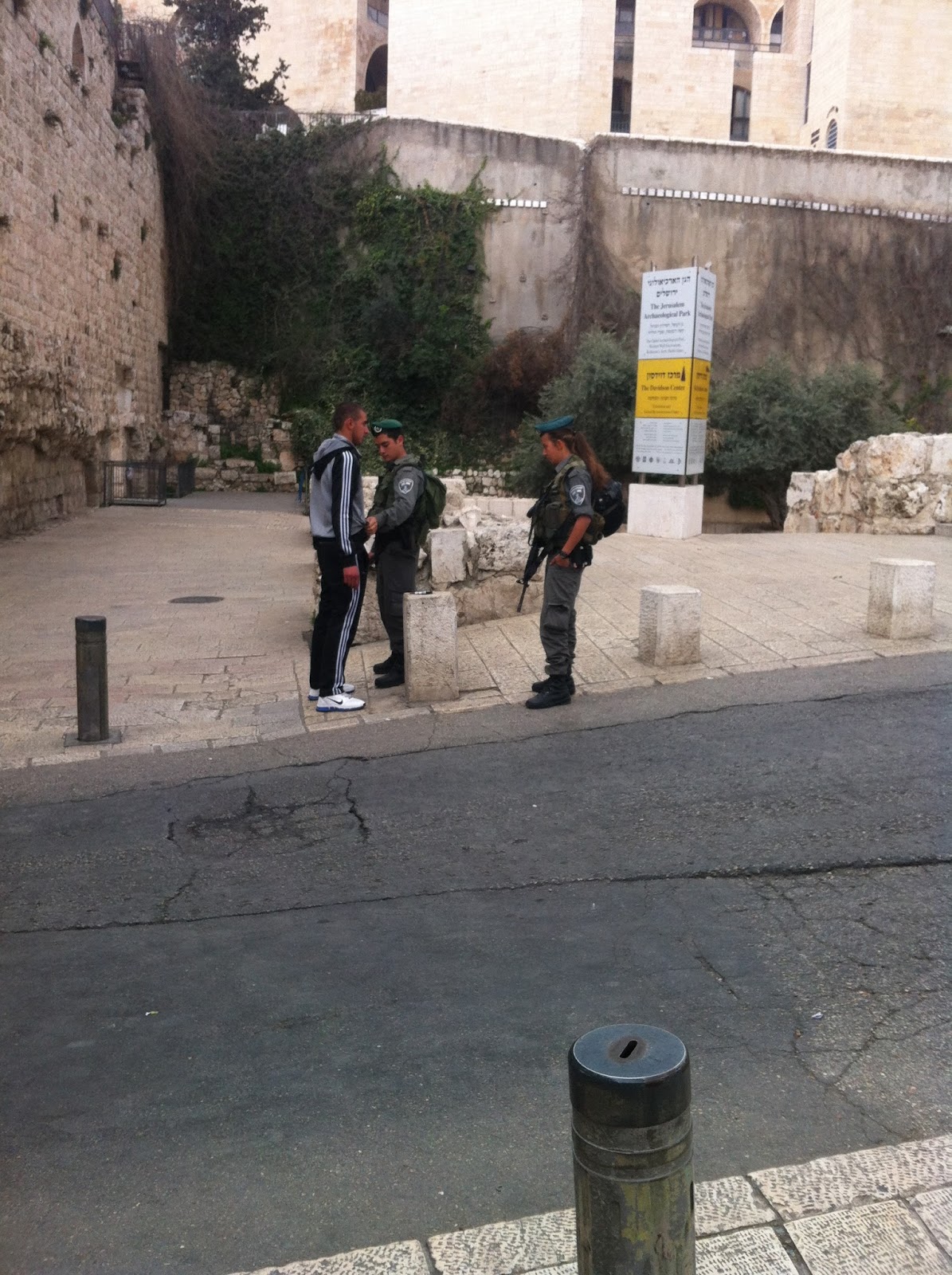
Israeli soldiers, machine guns at the ready, just inside the Lion's Gate.  They were sharing cigarettes with this man; smoking is very big in Israel. 
 
               Yet, God makes it clear in His Word that Jerusalem is important to Him.  We’re commanded to “Pray for the peace of Jerusalem” (Psalm 122:6).  This is where Jesus chose to redeem our souls in His atoning death, and conquer the grave on the first Easter.  It’s where the Church was born in the fires of Pentecost; those crowded streets yielded the first conversions that day.  It is the future capital of the New Earth (Revelation 21).  Jesus will one day reign from here.  I am so glad I had a chance to visit Jerusalem.  Whether it’s in this life or the next, I look forward to going back.