Monday, March 17, 2014

Israel--The Old City of Jerusalem


The busy streets of the Muslim Quarter.


 Note: I just returned from my first trip to Israel, and I am posting my thoughts and remembrances here.  In my previous post, I summarized the entire adventure.

We spent the better part of our trip in the Old City of Jerusalem, so I need to spend some time writing about this ancient city.  Jerusalem has an incredible history.  It originally belonged to the Jebusites, before it was conquered by David.  It was then Israel’s spiritual and political capital for centuries, until the Babylonians invaded, destroyed Solomon’s Temple and the walls of the city, then deported most of the people.  After the exile (foretold by the prophets), Cyrus the Persian King allowed the Jews to repopulate Jerusalem and rebuild the Temple. In the stunning Maccabean revolution, the Jews claimed independence from their Syrian overlords, and cleansed the Temple in an event the Jews commemorate at Hannukhah.  But their independence was short-lived.  By Jesus’ day, Jerusalem was a Jewish city under Roman rule. When the Jews rebelled in 68-70 AD (foretold by Jesus in Matthew 24, the Romans destroyed the Temple.  A second rebellion in 132-135 AD caused the Romans to expel all Jews from the city and name it Aelia Capitolina.   After the rise of Islam, Jerusalem was claimed as a Muslim city; the Dome of the Rock was built on the former site of the Temple.  During the Crusades, Christians conquered Jerusalem and declared it a Christian Kingdom, which lasted for nearly two hundred years before being reclaimed by Muslim warriors.  In 1948, the United Nations granted the Jews the homeland of Israel, leading to the Arab-Israeli war that year, and a tenuous co-existence between Jews and Palestinians ever since.  

Zion Gate.  Note the many bullet holes from the 1948 war.


Jerusalem is a modern Middle-Eastern city, but it surrounds an ancient walled city that in many ways is like traveling in a time machine to the biblical era.  This is the Old City of Jerusalem.  The Old City features narrow streets, many of them filled with merchants peddling food, clothes, souvenirs, and artwork; a massive wall with walkable ramparts, “loopholes” designed to allow archers to snipe at invading troops, and several historic gates; and amazing history on virtually every square inch.  In Texas, we love to visit places like the Alamo, San Jacinto, and Gonzales, where momentous events occurred two centuries ago.  In Jerusalem, I walked in a city where history was made two millennia ago—and more.  The city is so filled with history, Tim showed us a lamp post built on a column inscribed with the names of Roman soldiers stationed here two thousand years ago; in America, we would venerate such an object.  In Jerusalem, it’s a lamp post.  There are approximately 40,000 people living in the Old City today; According to Josephus, there were around a million people in the city when the Romans destroyed it in 70 AD.

One of many "loopholes" in the wall.  These allowed archers to snipe at invading troops.
  
A lamp post built on a column listing members of a Roman legion in the city nearly two thousand years ago.

The Old City is full of cats. Every day, the kids in our group counted cats, and usually reached at least 40.  Their exploits at night didn't help my sleeping issues.


The Old City is divided into quarters belonging to the Jews, Muslims, Christians, and Armenians.  Actually, the Christian population is declining dramatically. Jerusalem is mostly a Jewish and Muslim city.  We stayed in the Muslim Quarter.  We were awakened every morning at 4:00 by the call to prayer broadcast over loudspeakers at one of many mosques in the city.  The people working in our hostel, as well as the merchants we passed every day as we walked to our sites, were Palestinian Muslims.  Most of them speak at least some English, and they were uniformly friendly to us.  However, I can’t deny that I felt extremely out of place in the Muslim Quarter.  On our first Friday there, we were eating lunch outside a Falafel stand when the Muslim noon prayer time ended.  Suddenly, men and boys started yelling loudly from the various shops in the street around us.  It sounded like a riot was about to break out.  Nita explained to us that they were merely touting their wares, shouting something similar to “Three pounds for ten shekels.”  Arabic is an angry-sounding language, a fact I was reminded of several times in Jerusalem, where ordinary conversations can sound like to a foreigner like the beginning of a fistfight.  The streets here are old, dirty, narrow, and steep.  From the time the sun comes up, they are packed with shoppers, pedestrians, merchants beckoning people to come inside their shops or pushing carts full of fruits and vegetables up small ramps, and the occasional motorcyclist.  I was thankful that we got started each day before sunrise; the streets were quiet and empty then. 

An Old City street in the early morning, just before the city wakes up.  Note how steep it is, and the small ramps for merchant's carts.
 
               The Jewish Quarter is very different.  The streets and buildings are newer, cleaner, more modern.  This is partially because the Jewish Quarter was destroyed during the 1948 war, and has since been rebuilt.  Here, you are more likely to see Western-style shops and restaurants, although everything is still in Hebrew and Arabic.  When walking through the Old City, one is often unaware that he is walking forty or fifty feet above history.  The entire city has been destroyed and rebuilt so many times, the biblical streets and houses are several stories below the surface.  Only in the Jewish Quarter (because of its twentieth century destruction) and under several churches has there been excavation. Tim reminded us several times, ruefully, that only God knows what amazing things we’d find if we could excavate further.  Unfortunately, that probably won’t happen unless there’s another war; something none of us hopes for.  

A bar mitzvah procession through the Jewish Quarter.  Families go to great expense to celebrate the impending manhood of their sons.  Small bands lead the family through the streets with music to the Western Wall, where the boy reads from the Torah publicly for the first time.

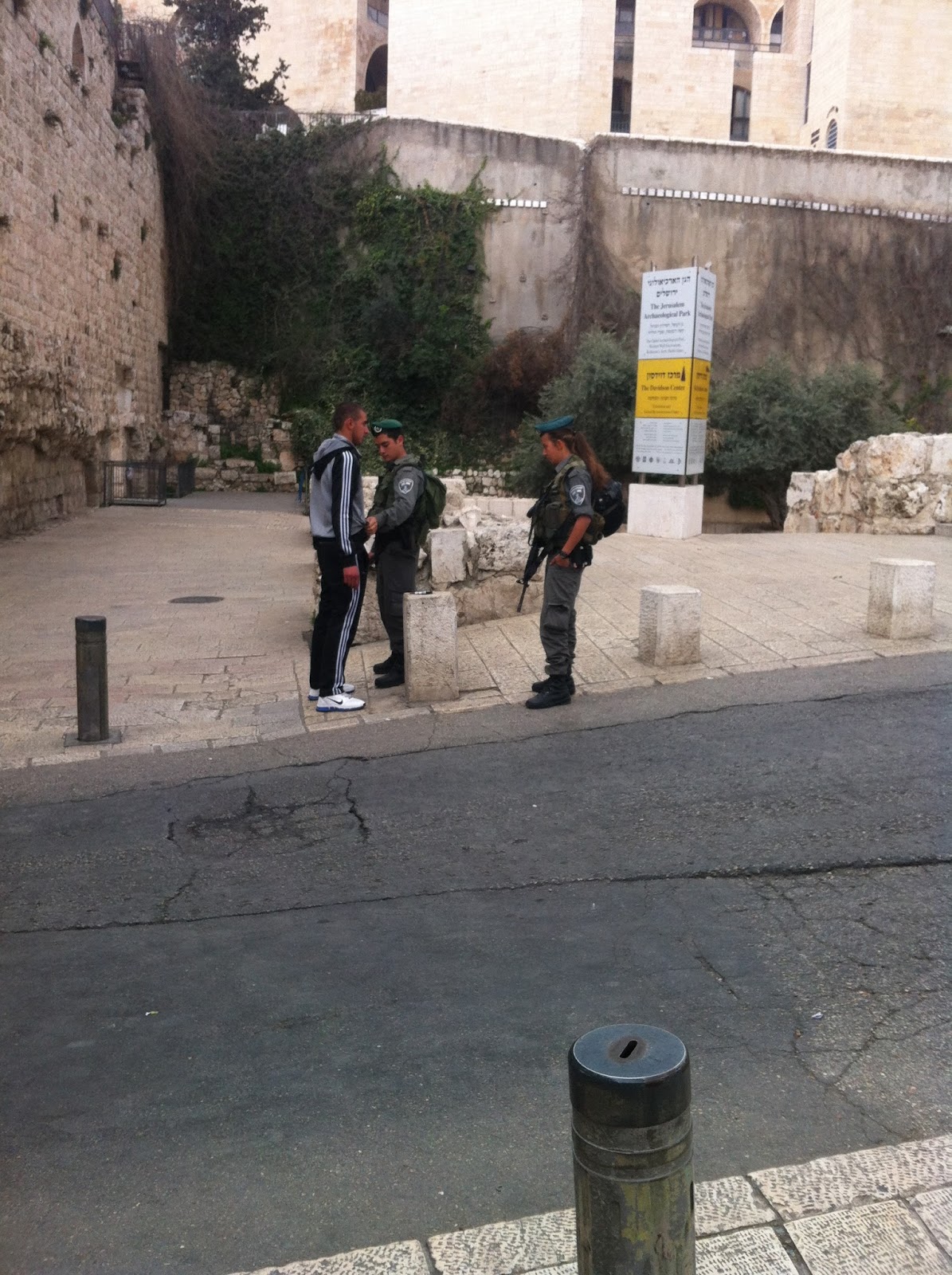
               There is great tension in Jerusalem.  It is considered the spiritual home of the world’s three great monotheistic religions: Christianity, Judaism, and Islam.  Everywhere I walked, I saw Israeli soldiers with machine guns.  Most of them looked around eighteen; military service is compulsory in Israel for men and women, aside from the Orthodox Jews.  We experienced some of the anger simmering just below the surface on our trip to the Temple Mount (more details in my next post).  I felt safe there (and Tim reminded us that no American tourist has ever been killed in the Old City), but I knew that the status quo cannot last forever.  Someday, this city will explode again. 

Israeli soldiers, machine guns at the ready, just inside the Lion's Gate.  They were sharing cigarettes with this man; smoking is very big in Israel. 
 
               Yet, God makes it clear in His Word that Jerusalem is important to Him.  We’re commanded to “Pray for the peace of Jerusalem” (Psalm 122:6).  This is where Jesus chose to redeem our souls in His atoning death, and conquer the grave on the first Easter.  It’s where the Church was born in the fires of Pentecost; those crowded streets yielded the first conversions that day.  It is the future capital of the New Earth (Revelation 21).  Jesus will one day reign from here.  I am so glad I had a chance to visit Jerusalem.  Whether it’s in this life or the next, I look forward to going back.      

Israel--a ten-day adventure

        Jerusalem as seen from the Mount of Olives.  This was Jesus' view as He walked to the city from Bethany every day during Holy Week.


I just returned from my first-ever trip to Israel.  Visiting the Holy Land has always sounded wonderful to me, but I never thought I would get to go.  Overseas travel is just too expensive.  Then this past Christmas, my uncle told me about a man who attends his church named Tim Rampey.  Tim and his wife Nita have been to Israel eleven times, and they enjoy taking groups primarily of preachers and Bible teachers, men and women who want a trip of serious learning instead of a vacation.  For reasons I will mention in the next paragraph, Tim is able to offer these trips at a relatively low cost.  It seemed like a once-in-a-lifetime opportunity.  Carrie gave me her blessing, as did my church, so I signed up.  Since I’ve returned, many friends and church members have asked me to share my experience with them. So here’s my summary of my trip to Israel.

The trip I took was rather unique.  Most people who visit Israel sign up with a major tour group.  They sleep in luxury hotels, where they sleep in, eat a nice breakfast, and ride a big bus to their sites.  They travel in big groups, visit a few key sites at a leisurely pace, and have plenty of time for shopping, meals, and relaxing.  My trip was more like an intense academic experience than a holiday.  We stayed most of our time in a hostel in the Muslim Quarter of the Old City of Jerusalem.  We woke up early, getting out the door by 6:00 AM at the latest.  We pushed ourselves hard every day for ten to twelve hours, visiting as many sites as possible, eating cheaply and walking almost everywhere. In fact, we averaged walking about seven miles a day.  We had little free time and minimal knowledge of what was going on back home. For a guy like me who had never traveled overseas before—and who enjoys a comfortable, predictable lifestyle--this was an adventure.  It was my first experience with jet lag, and quite frankly, jet lag kicked my tail; I had a tough time getting to sleep for the first half of the trip (I’m also now typing this at 4:00 in the morning, if that tells you anything).  I knew absolutely no one in my group of twenty travelers before the trip began.  I tried new foods, faced several fears, narrowly dodged a stomach virus that felled around half of our group, and had that unique and valuable experience of being constantly reminded I was an alien in a culture very different from my own.  Visiting so many sites every day felt like the proverbial “drinking from a fire hose” experience, so I am glad that I kept a journal and took around 180 pictures.
     
I’ll share some of the most meaningful experiences, insights I gained, and list my favorite places later in another post.  For now, I’ll just give a brief overview of our entire trip.  So, for those who have already been to Israel, and want to know whether I saw some particular site and experienced some specific event, here you go.  And for those who have never been to Israel, here’s a quick tour:

We flew out of Houston on Wednesday, March 5, at 8:00.  We landed at Ataturk Airport in Istanbul, Turkey twelve hours later, then had a two hour layover before our short flight to Tel Aviv, Israel. Tim had told us how important it was that we sleep on the plane, since we would be visiting sites as soon as we got to Jerusalem.  Unfortunately, Dramamine didn’t work for me; I only slept an hour or so.  It took much longer to get out of the airport in Tel Aviv than we expected, so it was after ten PM on Thursday when we arrived at the Golden Gate Hostel in the Old City of Jerusalem.  We took a quick walk to the Western Wall and got to bed before midnight.


 The Western Wall by night, with the Dome of the Rock in the background.

Here’s the rest of our itinerary for the week:

Friday, March 7:  Christ Church, the oldest Christian church in the Middle East; The Tower of David Museum; Mea Shearim, the Hasidic Jewish neighborhood; Church of the Redeemer—climbed to the top of the bell tower; Church of the Holy Sepulcher, the traditional site of Christ’s crucifixion, burial and resurrection…we watched a procession of Armenian Christians; we ended the day by visiting the Western Wall at sundown, as Orthodox Jews celebrated the beginning of Shabbat. 

Saturday, March 8: We went back to the Church of the Holy Sepulcher, then walked the Via Dolorosa to St. Stephen’s Gate. We visited the Orthodox Church of the Tomb of the Virgin, then climbed the Mount of Olives.  We went by the traditional site of Gethsemane, but didn’t go in.  We visited the Tombs of the Prophets, a cave where Zechariah, Haggai and Malachi and forty-seven of their disciples are thought to be buried.  We visited Absalom’s Tomb, and spent some time at the base of the southwest corner of the wall.  We then visited the Garden Tomb, the other possible spot of Calvary (more on this later).  We closed at St. Anne’s Church, by the Pool of Bethesda.  We sang inside the church; the wonderful acoustics made us sound like an amazing choir.

Inside the Tombs of the Prophets.  The man holding the candle in the center is a Palestinian Muslim whose family has lived on site for generations.  He was our guide for the site.

Sunday, March 9: We had a worship service in a quiet corner of the city. We then walked Hezekiah’s Tunnel, visited Solomon’s Quarry and the Ophel, and walked the Western Wall Tunnel.

Monday, March 10: We walked through the Zion Gate, passed by the cemetery where Oskar Schindler is buried, and spent time overlooking the Valley of Ben Hinnom.  We then visited the Cardo, a first-century “main street,” the Wohl Museum, where we saw an excavated house that may have belonged to the High Priest in Jesus’ day; walked the Ramparts at the top of the Jerusalem’s wall from the Damascus Gate to the Lion’s Gate, and visited Ecce Homo, an Ethiopian convent that contains ruins of the Fortress Antonia, where Jesus was flogged and Paul was arrested.  

Tuesday, March 11: We crossed the border fence into the West Bank; Palestinian territory.  We visited Bethlehem, including Solomon’s Pools, The Herodian, the Mar Saba Monastery, the Church of the Nativity, and the Milk Grotto. 

At Mar Saba Monastery in the desert just outside Bethlehem.  This was taken by Adam, a ten-year old Bedouin boy who followed me as soon as I arrived, and begged 5 shekels from me.  He knew how to operate an iphone camera. 

 Wednesday, March 12: Left Jerusalem.  Drove south to the Dead Sea.  Visited Masada; nearly got caught in a flash flood (more details later); went to the Dead Sea (yes, I got in, and yes, I floated); visited Ein Gedi, David’s wilderness stronghold (flooding meant we could only go as far as the first waterfall); Qumran, site of the discovery of the Dead Sea Scrolls; and Beth Shan.  We drove to Tiberias, where we would spend the rest of our nights at the Berger Hotel.  I felt right at home, naturally.  


The theater in Beth Shan.  That's Tim on the "stage."  He spoke to us in a normal voice, and we could hear him while sitting in the top row. Ancient people understood a few things about acoustics.

Thursday, March 13: We drove partway up Mt Hermon to Nimrod’s Fortress.  Mt Hermon is the only high mountain in Israel; there is actually skiing here.  It was very cold.  We then visited Banias (known as Caesarea Philippi in the New Testament era); Tel Dan; Capernaum; and Chorazin.  We tried to visit Mt Arbel, but it was unexpectedly closed.  We ended the day with a boat ride on the Sea of Galilee. 

Friday, March 14: We drove to Nazareth, where we visited the Church of the Anunciation; Caesarea, the port city built by Herod to be a truly “Roman” city—and where Paul was imprisoned for two years; Beth Shearim, Megiddo, and Mt. Carmel.  We then drove to the airport in Tel Aviv for a 1:20 AM flight.


The view from the top of Mt. Carmel, site of Elijah's epic duel with the prophets of Baal.

Saturday, March 15: Our flight landed in Istanbul at 3:20.  We then had a layover until a 1:00 PM flight to Houston.  I managed to catch a few hours of sleep in the airport.  We landed in Houston after 8:00 PM Houston time.  After the long process of deplaning and going through customs, I got home and in bed by 11:00.  I was up at 6 the next day for Sunday church!

In my next post, I'll talk about the amazing city of Jerusalem.  

Thursday, February 27, 2014

Downward Mobility

The Academy Awards are this Sunday night.  I have no idea who will win, but I will make this prediction: Most of the people who do win will take most of their speech time to thank their fellow cast members, directors, writers, producers, makeup artists, and if they are wise, their spouses.  They will say something like, “This award really belongs to you.  I’m nothing without you.” They will mention their fellow nominees and say, “I am honored just to be mentioned in the company of such amazing artists.”  In fact, if someone flips the script and acts in a way that smacks of arrogance and self-promotion, I predict it will be headline news tomorrow.  Imagine someone says, “It’s about time you pathetic fools recognize my greatness.  I shall now pause to allow you to bask in my radiance.  You’re welcome.”  We’ll be talking about it for weeks to come, in very negative terms.  But the question is why?  Why do we insist that people who win—in entertainment, athletics, or any other field—behave in a humble and gracious manner?  That certainly hasn’t always been the case.  We’re in a series now called “The Man Who Changed Everything,” talking about the many ways Jesus changed our world.  One way He did this was by turning humility from an insult into a virtue.  He changed the way we view greatness.  This Sunday, our sermon will examine John 10:35-45, how Jesus' radical teaching on true greatness changed the world forever.

Wednesday, February 19, 2014

With All Your Mind


I grew up in the country.  I wouldn't trade that for anything.  I had a wonderful childhood.  My parents made sure I knew how to raise animals and help my grandfather with his corn, peas and potatoes.  But they also made sure that I had a well-rounded education.  My parents are the kind of people who raise cattle AND attend classical music concerts, so they wanted me to know things beyond my small world.  They made sure I was well-read.  I had many excellent teachers, and my parents insisted I listen to them.  Many of our vacations were to historical sites.  My dad especially was good about teaching me to question my assumptions.  If I came home spouting some opinion I had picked up from my friends, he would ask me questions that would often show me how I hadn’t really thought that idea through.  And when I came to the end of my high school years, my parents didn’t insist that I stay home and go to Victoria College so they could keep an eye on me, or send me to some “safe” college where everyone thought just like I did.  They were fine with me choosing a University in a big city, where I would be surrounded by all types of people.  My mom told me, “This is the way the world is.  You need to learn how to relate to all kinds of people.”  Unfortunately, not everyone in my small town thought that way.  I had been raised to be intellectually curious, but I felt like I needed to keep that to myself around most of my friends, and even a lot of the adults I knew.  If I happened to use a word that was longer than two syllables, people acted like I had made a faux pas. I remember at times being frustrated by the small-mindedness of my rural surroundings. When I left that behind and came to a college environment with people who were excited about learning, and who didn't think exactly like me, it felt like liberation.  
 
So I can relate to young adults today who are leaving the Church in droves.  Many of them say they feel like Christianity is intellectually confining and closed-minded.  They learn new things in their studies or in conversations with people who aren’t Christians, things which they haven’t heard in church.  When they ask questions to try to reconcile this new information with Scripture, too often they are made to feel ashamed, as if asking questions is a bad thing.  They hear from their non-Christian friends and professors that faith and reason are two separate fields; they increasingly begin to feel like to continue following Jesus will mean turning off their brains, and they simply cannot do that.  If you feel that way, or know someone who does, this next sentence is very important: Jesus never made anyone choose between their brain and their faith. 


We’re in a series now called “The Man Who Changed Everything.”  We’re looking at the continuing impact Jesus made on the world.  Last week, we looked at how Jesus changed the way we view needy people. This Sunday, we’re going to look at how Jesus changed the way we think.  We'll talk about what it means to love God with all our minds.  I hope you'll be there!

Thursday, February 13, 2014

The Man Who Changed Everything


Two hundred years ago, the most influential person on earth was Napoleon, Emperor of France.  He had managed to conquer most of Europe.  But then he met his Waterloo, as they say, and I can’t think of a single way his life directly influences us today.  One hundred years ago, arguably the most influential man on earth was Kaiser Wilhelm II, the ruler of Germany.  His nation was the prime mover that caused a regional conflict in the Balkans to turn into World War I.  Wilhelm died in exile, and today, very few people know much about him.  Who is the most influential person in the world today?  You could make the argument that it's the late Steve Jobs, who pioneered so much of the technology that has changed the way we live.  But there will be new and greater innovations in the years to come.  Someday--probably soon--we’ll look back on the name of Steve Jobs the way we today look at the name of Marconi, the inventor of the radio. 


Now consider this: There was a man who lived over 2000 years ago whose life directly impacts this planet in too many ways to list.  History is literally divided into everything before Him, and everything after Him.  To this day, putting His face on a magazine cover--any magazine cover--virtually guarantees a 50% spike in circulation.  Even people who are not believers in His divinity are astonished at the range of His influence.  For just one example, here’s a quote from HG Wells:  “A historian like myself, who doesn’t even call himself a Christian, finds the picture centering irresistibly around the life and character of this most significant man…the historian’s test of an individual’s greatness is ‘What did he leave to grow?’  Did he start men to thinking along fresh lines with a vigor that persisted after him?  By this test Jesus stands first.” 
            All this year, I am preaching on the theme, “Who is this God?” We’re talking about the attributes of God according to Scripture.  We’ve already seen that God is holy.  But according to Scripture, God became a man named Jesus.  That means that for 33 years, God lived in flesh on this Earth.  So the best way to know Him fully is to study the life of Jesus.  Starting this Sunday--Feb. 12-- and continuing until Easter Sunday, that is exactly what I will be doing.  The title of this series is, “The Man Who Changed Everything.”  I strongly suggest that you study the Gospels—Matthew through John—during this series.  If you’d like to read something supplemental, I recommend the book Who Is This Man? by John Ortberg, from which I will be using some quotes, stories and ideas.  I will be focusing on some of the ways the life and teachings of Jesus still impact the way we live today, 2000 years later.  I hope you will invite friends to this series, especially friends who haven’t yet decided what they believe about Jesus.  But the series isn’t only for them. I have discovered, over and over again, that the richest, most exciting and fulfilling thing I can do is get to know Jesus better. If you will go on this journey with me, it will bless your life…and may change it forever.

Thursday, February 6, 2014

Holy Fear


He was the richest man in the world, and was also the most brilliant man who had ever lived.  Combine that with absolute political and military power, and you have a man who was literally living the dream of every human, and especially every male, on earth.  So what do you get the man who has everything?  Well, this particular man wanted happiness, fulfillment, a sense of purpose.  He wanted his life to count.  So he used his riches and power to woo beautiful, desirable women.  He could have literally any woman he wanted, and took full advantage of that fact.  He embarked on huge building projects.  He designed cities and conscripted workers to build these majestic monuments to his greatness.  He enjoyed the best food, wine and entertainment money could buy.  He pursued greater knowledge in every field of learning available at that time, and then made himself famous.  People came from other nations to listen to his wisdom and knowledge, and they showered him with gifts, making him even richer than before.  Then he reached that point in life when he began to assess things.  He decided to write a memoir, something that would offer the lessons of his life to future generations. That memoir is what we call the book of Ecclesiastes.  It’s the diary of an old man who regrets most of his life.  It is unique among all the books of the Bible, because it focuses primarily on what NOT to do.  Ecclesiastes was written by a man who calls himself The Teacher (Qoheleth in Hebrew), but it’s obvious from the way he describes himself that this is Solomon, the son of David, king of Israel.  Nothing brought him the happiness and fulfillment he sought, not sex, achievements, power, pleasure, riches, fame or knowledge.  But note how Solomon ends his depressing diary:

            Now all has been concluded, here is the end of the matter: Fear God and keep His commandments, for this is the whole duty of man.

            Let’s put this another way: Imagine you had lunch with a man who has the power of a president, the lifestyle of a rock star, the riches of Warren Buffet, the knowledge of Stephen Hawking.  He’s done everything there is to do, owned everything there is to own, and learned everything there is to learn.  And you say to him, “What can I do to live the best life possible?”  He says, “Fear God.”  Then he hands you a Bible.  You open it to find that he has highlighted over 300 references to the fear of God.  As you read, you find that, according to Scripture, a person who fears God lives a life full of delight, joy and increasing knowledge.  He becomes the person he was created to be, and steers clear of the self-destructive choices that others make. He influences the people around him as well as the generations who come along after him, for good.  In other words, the person who fears the Lord truly lives a life worth living.   But you’re still confused.  You say, “Fear God?  What does that even mean?  I believe in God, but how do I know if I truly fear Him?  And if I don’t, how I can learn to fear Him as I should?”  We’ve been talking since the first Sunday of the year about the holiness of God. Scripture makes it clear that the only proper way to relate to a God this holy is in holy fear.  But we don’t tend to talk about that in churches these days.  So this Sunday I want to answer those three questions I asked earlier: What is the fear of God?  How do I know when I have it?  And what can I do to get it?

Tuesday, February 4, 2014

My response to Coke's Super Bowl ad

Did you see the Coke Ad during the Super Bowl this year?  Every year, it seems, there is at least one Super Bowl commercial that becomes a point of public discussion.  This year, it's Coke's ad, featuring the song "America the Beautiful" sung in several different languages.  The controversy revolves around angry comments made by some viewers on Twitter, who resented "their" song being sung in languages other than English.  I will not rehash those comments here; they can be found with an easy search, and some are referenced in Jim Denison's excellent commentary that I link at the bottom of this post.   

My response to the "controversial" Coke ad:

 1. I doubt there is much controversy, actually. The internet allows people to anonymously say awful things they wouldn't have the courage to say in public. And we give them attention for this! (Yes, I realize I am doing that right now. The irony).

 2. One of the great things about our country is that is a melting pot of hundreds of different cultures and languages. Yes, my forefathers spoke German when they first got here.

3. As ...an American, I am happy to hear people sing for God to shed His grace on my country in any language, thank you very much. 

4. I live in the most diverse city in America. Whether or not I am comfortable with that fact, my Christian faith demands that I see it as an opportunity, not a burden. This commercial, whatever its motives, reminded me that the mission field is here.

 5. As Jim Denison's article (linked below) says so well, we are called to hospitality towards aliens and strangers. Period.